

Immunotherapy has profoundly changed the way some types of cancer are treated. Instead of directly attacking tumor cells with cytotoxic substances, it seeks to activate, redirect, or release the brakes on the immune system so that it can recognize and fight the disease. Thanks to this approach, some patients with advanced or resistant tumors have achieved responses that were previously difficult to obtain.
However, activating the body’s defenses also involves a delicate balance. The immune system must react with enough intensity to attack the tumor, but without losing the ability to distinguish between cancer cells and healthy tissues. When this control is disrupted, so-called immune-related adverse events, known as irAEs, may appear.
A review published in Toxicology Reports analyzes this challenge precisely: how to identify, monitor, and treat these toxicities without losing the benefits of immunotherapy. The article addresses different strategies, such as immune checkpoint inhibitors, monoclonal antibodies, and cytokine therapies, and highlights that their safe use requires prior assessment, constant monitoring, and individualized care.
How Does Immunotherapy Work?
The immune system has mechanisms capable of recognizing abnormal cells. However, tumors can develop ways to hide, reduce their visibility, or send signals that decrease T-cell activity. Some immunotherapies seek to neutralize precisely those signals.
Immune checkpoint inhibitors block molecules such as CTLA-4, PD-1, or PD-L1. These molecules normally function as brakes that prevent the immune response from becoming excessive. By blocking them, lymphocytes can regain part of their ability to attack the tumor. This principle has revolutionized the treatment of different cancers, although it can also promote the development of inflammation and autoimmunity.
In addition to these drugs, there are monoclonal antibodies directed against specific targets, cellular therapies such as CAR-T cells, therapeutic vaccines, and cytokine-based treatments. Each modality acts differently and, therefore, has a particular profile of benefits and risks.
When the Immune System Also Attacks Healthy Tissues
Immune-related adverse events arise when immune activation extends beyond the tumor and begins to affect healthy organs. In simple terms, the body’s defenses partially lose the tolerance that normally prevents them from attacking the body itself.
These reactions may appear during treatment, shortly after it ends, or, in certain cases, months later. Their intensity also varies. Some people develop mild and manageable alterations, while others may experience serious complications that require hospitalization, treatment interruption, and immunosuppression.
The reported manifestations include dermatitis, colitis, and other inflammatory reactions that usually respond to supportive treatment or corticosteroids. More severe cases may include pneumonitis, myocarditis, neurological complications, or cytokine release syndrome, a hyperinflammatory state caused by the excessive release of immune signals.
The problem is that these events can resemble many other diseases. Fatigue, diarrhea, cough, difficulty breathing, skin rashes, muscle pain, or changes in organ function are not always immediately recognized as a consequence of immunotherapy. Therefore, the timing of symptom onset and communication with the medical team are essential.
The Risk Is Not the Same for Everyone
Not all patients have the same likelihood of developing significant toxicities. The risk depends on the drug used, the dose, the treatment combination, the person’s general condition, and their medical history.
For example, the combination of CTLA-4 and PD-1 inhibitors may produce a higher incidence of severe adverse events than the use of a single drug. Likewise, certain therapies may be associated with particular toxicity patterns. The review notes that some neurological complications have been associated with PD-1 inhibitors, although each patient’s response remains difficult to predict.
Advanced age, the presence of several simultaneous diseases, previous organ damage, and a history of autoimmune disorders also require careful evaluation. A pre-existing autoimmune disease does not necessarily exclude a person from receiving immunotherapy, but it may require specialized assessment and closer monitoring.
Safety Begins Before the First Dose
The initial assessment of a patient is important in order to predict their likelihood of developing irAEs. It includes a detailed medical history, review of autoimmune diseases, previous infections, current medications, and possible abnormalities in organs such as the liver, kidneys, lungs, or heart. Complete blood counts, liver and kidney function tests, inflammatory markers, and imaging studies such as CT scans, magnetic resonance imaging, or PET scans may also be performed. In patients with a history of cardiovascular disease, an electrocardiogram or echocardiogram may be necessary.
These studies establish a baseline. This means that they make it possible to determine the patient’s condition before beginning immunotherapy. If an abnormality subsequently appears, the medical team can compare the new results with the initial values and determine whether there may be a treatment-related effect.
Biomarkers also play a fundamental role. PD-L1 expression and tumor mutational burden are mainly used to study the likelihood of response to certain checkpoint inhibitors. Other analyses, such as HLA typing, cytokine profiles, and specific genetic variants, are being investigated to identify patients who may be more susceptible to developing toxicities. However, there is still no single test capable of accurately predicting who will experience a severe adverse event.
Monitoring the Patient From Different Angles
The safe monitoring of immunotherapy is based on three main components:
- Laboratory tests
- Imaging studies
- Clinical evaluation
Blood tests can detect changes in immune cells, cytokines, and the function of different organs. Monitoring these variables may reveal inflammation or metabolic abnormalities before serious damage occurs. The article also mentions the study of the neutrophil-to-lymphocyte ratio, as well as the measurement of cytokines such as interferon gamma, although their usefulness must be interpreted within each patient’s clinical context.
Imaging techniques, such as CT, MRI, or PET, make it possible to observe the tumor response and look for inflammation in non-tumor organs. Liquid biopsies, for their part, represent an emerging strategy for analyzing circulating tumor cells and other components present in the blood.
However, no technology replaces communication with the patient. Physical examination and symptom monitoring remain essential. Some early changes may be perceived by the person before they become visible in a laboratory test or an imaging study. The coordinated combination of these methods makes it possible to detect problems before they become serious or irreversible injuries.
What Happens When Toxicity Appears?
Treatment depends on the organ affected and the severity of the event. In mild toxicities, close monitoring and symptom treatment may be sufficient. In moderate or severe cases, temporary interruption of immunotherapy and the use of corticosteroids to reduce immune activity are usually considered.
When inflammation does not respond adequately, other immunosuppressive drugs, such as infliximab or mycophenolate mofetil, may be used, depending on the type of toxicity and the organ involved. The decision must always be individualized.
The clinical guidelines cited in the review state that some grade 1 events can be managed through monitoring while treatment continues. In grade 2 to 4 toxicities, it may be necessary to interrupt the checkpoint inhibitor, administer corticosteroids, and use additional immunosuppressive drugs if the event is resistant.
The objective is not simply to shut down the immune system. Physicians must control inflammation without unnecessarily eliminating the antitumor effect. They must also decide whether it is safe to restart immunotherapy after recovery, considering the severity of the episode, the organ affected, the response obtained against the cancer, and the patient’s preferences.
The Patient Is Also Part of the Monitoring System
Education is a safety tool. Before beginning treatment, the person needs to know which symptoms should be reported and understand that even an apparently minor change may be relevant.
Early reporting of persistent diarrhea, difficulty breathing, chest pain, unusual weakness, or an extensive rash may allow intervention before inflammation progresses. Waiting until the next appointment or self-medicating may delay diagnosis.
Education should not be limited to an initial conversation. It should be reinforced throughout treatment through clear materials, follow-up consultations, care lines, and nursing support. The review highlights that empathetic communication also improves adherence, reduces anxiety, and helps the patient actively participate in decisions related to their treatment.
A Treatment That Requires Teamwork
Because immune-related events can affect virtually any organ, their management requires collaboration among different professionals. The oncologist may need the support of pulmonologists, cardiologists, gastroenterologists, neurologists, endocrinologists, dermatologists, rheumatologists, or nephrologists.
Nursing teams play an especially important role because they often maintain frequent contact with patients, identify early changes, and reinforce instructions regarding symptom reporting. Pharmacists, for their part, help review interactions, adjust medications, and prevent complications related to treatment combinations.
Coordination among these areas makes it possible to respond quickly and prevent an initially manageable toxicity from progressing to permanent damage.
Technology, Artificial Intelligence, and Remote Monitoring
The review also analyzes tools such as wearable devices, telemedicine, and artificial intelligence. Smartwatches, biosensors, and wireless patches could record heart rate, temperature, oxygen saturation, blood pressure, and physical activity. These data could help detect early signs of inflammation, cardiac abnormalities, or general deterioration.
Artificial intelligence systems could integrate clinical data, imaging, immune profiles, and biomarkers to recognize risk patterns. However, these tools still face challenges related to data quality, bias, privacy, integration with hospital systems, and the difficulty of interpreting some models. Therefore, they should be understood as supportive tools rather than replacements for medical judgment.
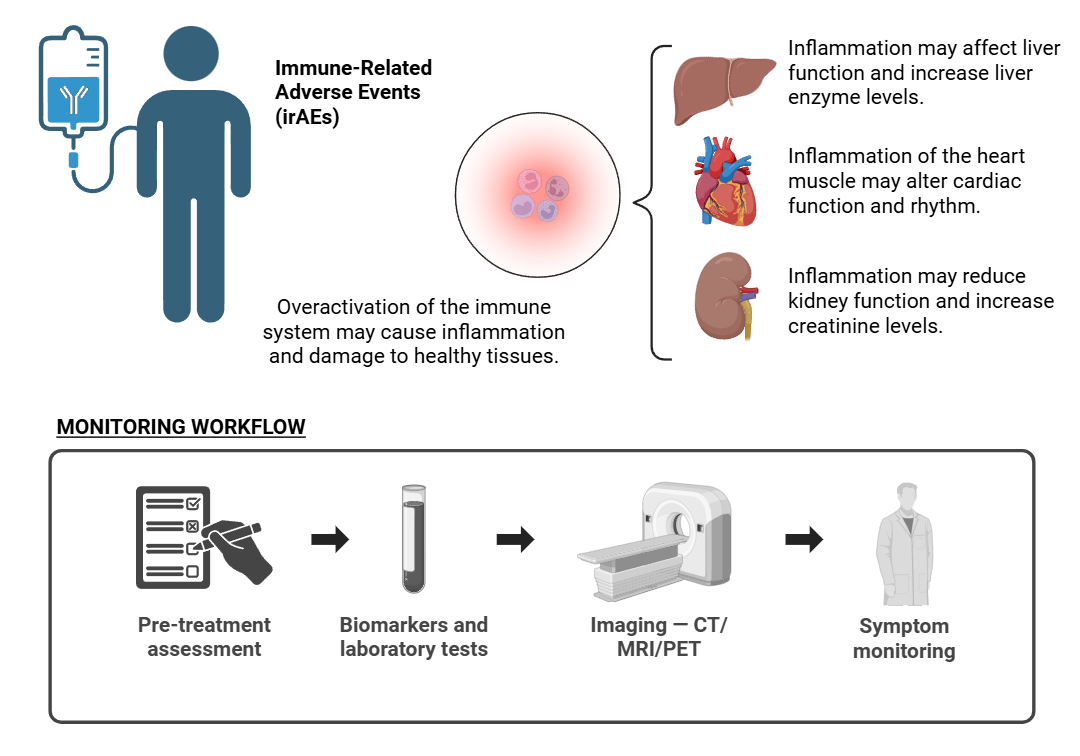
Figure 1. Overactivation of the immune system may cause inflammation in healthy organs, highlighting the importance of pre-treatment assessment, laboratory testing, imaging, and continuous symptom monitoring.
Finding the Balance
Immunotherapy demonstrates that stimulating the body’s defenses can be a powerful strategy against cancer, but it also reminds us that a stronger immune response is not always better. The true challenge is to direct that response toward the tumor while protecting the rest of the body.
Achieving this requires carefully selecting patients, establishing baseline values, monitoring symptoms and organs, acting quickly in response to toxicities, and adapting decisions to each case. It also requires the patient to understand their treatment and maintain continuous communication with a multidisciplinary team.
Immunotherapy should not be viewed only as a drug administered at specific intervals. It is a clinical process that requires monitoring before, during, and after each dose. The earlier an immune alteration is recognized, the greater the chances of controlling it without compromising the patient’s safety or the benefits of treatment.
Main reference:
Siddiqui, M. A., Usmani, A., Ansari, M. N., & Almoselhy, R. I. M. (2025). Immune-related adverse events in immunotherapy: Challenges in diagnosis, monitoring, and management. Toxicology reports, 14, 102036. https://doi.org/10.1016/j.toxrep.2025.102036
Other references:
Puzanov, I., Diab, A., Abdallah, K., Bingham, C. O., 3rd, Brogdon, C., Dadu, R., Hamad, L., Kim, S., Lacouture, M. E., LeBoeuf, N. R., Lenihan, D., Onofrei, C., Shannon, V., Sharma, R., Silk, A. W., Skondra, D., Suarez-Almazor, M. E., Wang, Y., Wiley, K., Kaufman, H. L., … Society for Immunotherapy of Cancer Toxicity Management Working Group (2017). Managing toxicities associated with immune checkpoint inhibitors: consensus recommendations from the Society for Immunotherapy of Cancer (SITC) Toxicity Management Working Group. Journal for immunotherapy of cancer, 5(1), 95. https://doi.org/10.1186/s40425-017-0300-z
Ameri, M., Al-Zubidi, N., & Lee, A. G. (2024). Immune checkpoint monoclonal antibody-related adverse effects in neuro-ophthalmology. Saudi journal of ophthalmology : official journal of the Saudi Ophthalmological Society, 38(1), 25–28. https://doi.org/10.4103/sjopt.sjopt_296_23


